Routes that arrive.
For what carriers actually bill, and actually deliver.
Every routing engine optimizes on the same two things: the carrier's posted rate and the carrier's posted transit time. Toretto's optimizer does the math that actually matters — predicted billed cost (with surcharges and accessorials) and actual on-time performance, learned from your own audit and tracking history.
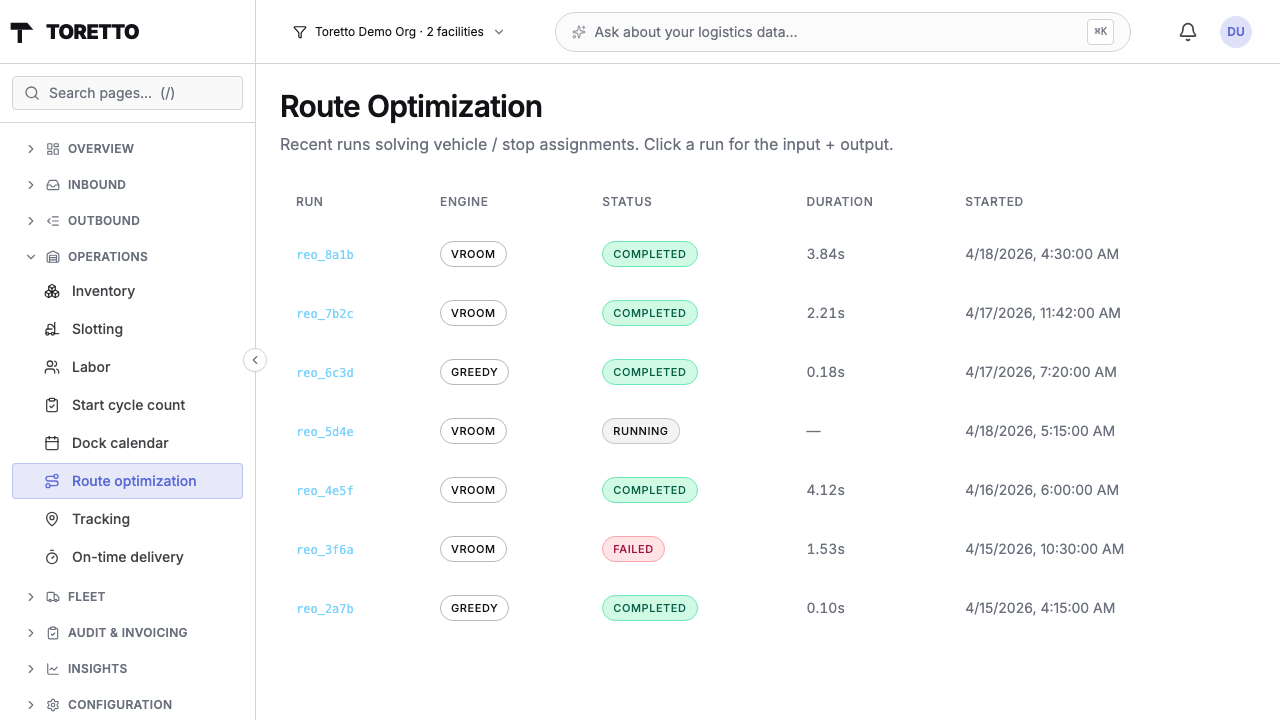
Every optimization run is replay-able — engine, status, duration, full input snapshot, output plan. Click into any run for the per-stop breakdown.
Four signals no standalone routing engine has
Toretto's optimizer plugs into the same data the audit and tracking modules already collect. Every routing decision is informed by what actually happened on your network, not what the carrier said would happen.
Empirical transit time
For every carrier × origin × destination × service
lane, we compute the median and tail (p90, p95) of actual
transit times from your delivered shipments. The carrier's
posted transit table is a baseline — your history is the truth.
Lane reliability score
On-time delivery percentage per carrier per lane, computed from tracking events on a rolling 90-day window. Surfaced inline at rate-shop time so dispatchers see "94% on-time, n=87" next to every carrier choice — not a generic vendor scorecard.
Shipment sensitivity
Each shipment carries a 0–100 sensitivity score auto-computed from customer tier, days-to-promise, and commodity (or operator-overridable). A cheap unreliable carrier doesn't win a high-sensitivity shipment, even if it'd save 8% on cost.
Audit-cost optimization
Cost-per-carrier isn't the posted base rate. It's the predicted billed cost — base + fuel surcharge + accessorials, computed from the contracted rate card the Audit module already owns. Optimize on what carriers will charge you, not what they advertise.
Standalone routing vendors (Onfleet, Routific, OptimoRoute) don't have your rate cards. Audit-only vendors don't have a route engine. Toretto owns both modules — and adds reasoning trails on every routing decision so the "why" is one click away.
From your data to a better decision
Every routing decision composes four signals — three of them unique to Toretto because of what the platform already collects.
Audit history → predicted billed cost
For each carrier choice, Toretto computes base rate + fuel surcharge + accessorials from your contracted rate card. The result is a billed-cost estimate with a confidence band — operators see "$241.50 ± $8" instead of the carrier's flat posted rate.
Tracking history → empirical on-time %
A nightly job rolls up the last 90 days of delivered shipments into a rolling per-lane distribution — carrier × origin zip3 × dest zip3 × service. Median transit, p90, p95, and the on-time percentage under your tolerance window (configurable per customer).
Shipment context → sensitivity weight
Each shipment gets a 0–100 sensitivity score auto-computed from customer tier, days-to-promise, and commodity type. Operators can override. A high-sensitivity shipment will never lose a routing decision to a cheap unreliable carrier just because of price.
Composite score → recommendation + reasoning
The optimizer composes those signals into a single cost function and ranks every viable carrier choice. The top-ranked is recommended; every alternative's score breakdown is written to an append-only reasoning trail, so months later anyone can ask "why this carrier?" and get the answer in one click.
What you can solve today
TSP sequencing
"I have one driver and 30 stops — give me the right order." Nearest-neighbor seed plus 2-opt improvement, sub-millisecond solves, no external solver needed. Optional return-to-start for closed-tour routes.
VRP with constraints
"I have 12 vehicles and 200 stops with delivery windows and weight limits." VROOM-backed solver handles capacity, time windows, shift bounds, and feasibility — under 5 seconds on real road distances.
Scenario replay
Every run is saved with its full input snapshot. Re-solve yesterday's batch with a different distance provider, vehicle mix, or policy — side-by-side comparison shows you what changed and why.
Real distances, not as-the-crow-flies
A 10-mile straight-line hop is a 22-mile drive once one-way
streets, highway ramps, and bridge restrictions are accounted
for. Toretto's pluggable
DistanceProvider
gives every optimizer access to real road geometry.
Haversine
Pure straight-line math. Instant. Good for quick estimates and unit tests; the default when you don't specify.
OSRM
Self-hosted Open Source Routing Machine with continental US road graph. Sub-second distance matrices for hundreds of stops, no per-request API fees.
Valhalla (roadmap)
Truck-aware routing — height, weight, hazmat, axle restrictions. The right tool when "shortest road distance" isn't a route a truck can actually drive.
What you get in the app
Route planner UI
Pick a vehicle (or skip for pure sequencing), select stops from your shipment list, choose engine + distance provider, and dispatch. The plan renders on a map with leg-by-leg distance and duration.
TMS integration
POST /optimize-from-tms
pulls shipment orders and fleet vehicles directly into the
engine. The dispatched plan writes back to your shipment
assignments.
Replay-able runs
Every optimization run is stored with its full input snapshot (vehicles, stops, distance matrix) and output plan. View a run weeks later and reconstruct exactly what was solved.
Telematics-aware
GeoTab and Samsara feeds populate vehicle locations automatically. Re-route around in-progress drivers without disrupting completed stops.
How it's built
Optimization core in a workspace crate, called from the API server.
C++ VRP solver — sub-second solves for hundreds of stops.
Self-hosted routing engine for road-network distances.
Geospatial storage for stops, vehicles, and historical routes.
See it solve your real routes
Bring a recent batch of stops and a fleet profile. We'll run the optimizer live and walk through the plan.
Request a demo